
User, one desk, no keyboard.
A single user sending voice command using MultiPC VEGA from his computer to multiple computers located in his overseas offices: “Send finance report with AI analysis from India. Run test cases and send me the results from London. Fetch staff data from London as well.”
California hub routes the commands.
Behind the scenes, a California system becomes the hub. It turns that one voice request into structured packets targeting specific machines in India and London — not the whole network.
Remote systems prepare the results.
The remote systems open the right tools, run AI analysis and test suites, collect staff data, and assemble finished outputs — all without additional operators.
MultiPC VEGA steps into city operations.
Now think larger: a city command center watching live maps, camera feeds, and traffic flows. The same voice-first orchestration routes actions through an entire urban grid.
“Create a green corridor for Ambulance A-12.”
The operator issues a single command: “Create a green corridor from Mercy Hospital to Junction 18 for Ambulance A-12.” The route path lights up across the city map.
AI orchestration validates the corridor.
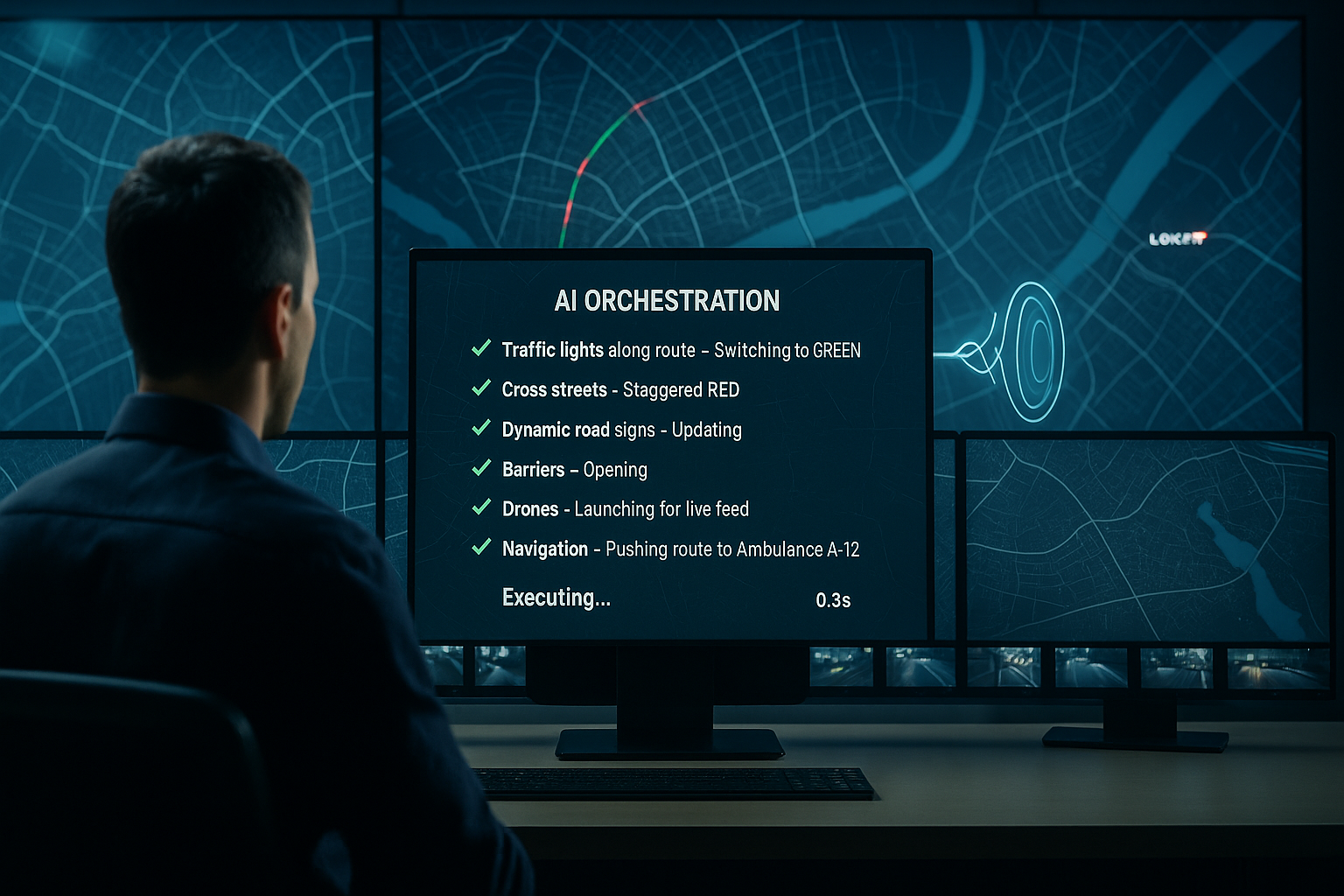
A digital checklist confirms: signals are paired, paths are clear, devices are online. The corridor is simulated and verified before a single light changes.
Traffic lights form a living corridor.
Along the chosen route, intersections flip to green in sequence, creating a moving wave of “Priority Green” that carries the ambulance forward.
Signs and barriers adapt around the corridor.
Overhead gantries warn: “EMERGENCY CORRIDOR — KEEP RIGHT”. Side-street bollards lift, and pedestrian crossings lock, keeping the path clean without manual coordination.
Drones and cameras watch the corridor.
Live tiles show the ambulance moving through the city as drones and fixed cameras monitor head-on traffic and bottlenecks in real time.
Progress tracked at every checkpoint.
A route timeline shows the ambulance passing node by node: “Checkpoint 3/9 — Clear” with ETA and corridor health updating live.
Operation complete, metrics captured.
A completion card confirms: ambulance A-12 arrived. Time saved, signals controlled, signs updated, and incidents are all recorded for audit and training.
“Run AI analysis on the whole corridor.”
With one more voice command, the operator asks for a full AI review of every signal, camera, drone, and billboard used in the operation.
All reports, one desk.
Logs and visuals converge back to the operator’s machine. AI compiles a unified report on corridor performance, risks avoided, and what to tune for next time.
One command. Many systems.
MultiPC VEGA and MultiPC Replicator are built for environments where one operator must safely orchestrate many endpoints — without losing control. Private alpha · Patent pending.